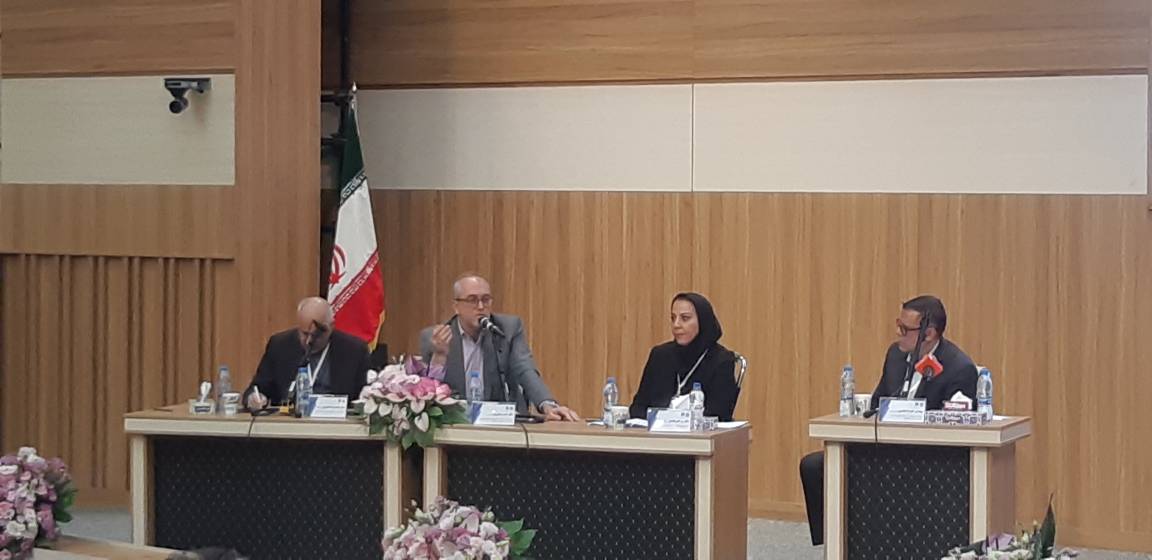
President of the Center for International Scientific Studies and Collaboration:
Effective International Memorandums of Understanding Require a Practical and Goal-Oriented Approach

June 15, 2026
According to the Public Relations Office of the Center for International Scientific Studies and Collaboration (CISSC), Dr. Omid Rezaei Far, President of the Center, addressed the First Conference on New Horizons in International Scientific Activities of Universities, Educational, Research, and Technology Institutions, jointly hosted by the University of Tehran and Tehran University of Medical Sciences on Monday, June 15. During his speech, he examined the challenges that have hindered the implementation of international memorandums of understanding (MoUs) in scientific cooperation and academic exchanges.
Dr. Rezaei Far emphasized that the large number of international MoUs is not inherently a negative or challenging phenomenon. However, he identified the lack of a common framework and shared understanding of intellectual property rights with international partners as one of the key barriers to implementing these agreements. He noted that this issue is often overlooked, even in joint technology and innovation projects.
He further pointed out that a considerable number of Iran’s international MoUs rely heavily on the individuals who negotiate and sign them. Many successful examples, he explained, are the result of the dedication and follow-up efforts of institutional leaders or distinguished faculty members. While this is not necessarily a weakness, excessive dependence on individuals may jeopardize the sustainability and continuity of international collaborations.
The President of CISSC also identified financial and economic issues as key factors limiting the realization of MoU objectives. He stated that successful international agreements require effective financial interaction during the implementation process, whereas only a limited number of Iran’s MoUs eventually develop into operational agreements with financial commitments. He also highlighted the imbalance between domestic financial support and the expectations and capacities of foreign partners as another major obstacle.
Referring to the content of many existing agreements, Dr. Rezaei Far noted that they generally focus on broad and general areas of cooperation. Experience has shown, however, that agreements centered on specific and operational objectives—such as implementing a large-scale joint research project or establishing shared laboratories—are far more likely to achieve successful outcomes.
He also identified the absence of well-structured collaborative mechanisms, including joint scientific consortia, as another important challenge. He stressed that safeguarding national interests in science, technology, and innovation requires the development and strengthening of such frameworks. Furthermore, he emphasized that educating and empowering specialized professionals—particularly experienced international relations experts in science, technology, and innovation diplomacy—can play a significant role in narrowing existing gaps and improving the quality of international cooperation.
In conclusion, Dr. Rezaei Far emphasized the importance of designing and implementing a National Dashboard for the Management of International Memorandums of Understanding, describing it as an effective tool for monitoring implementation, aligning the objectives and missions of participating parties, and enhancing the effectiveness of international agreements in support of the country’s national interests.